
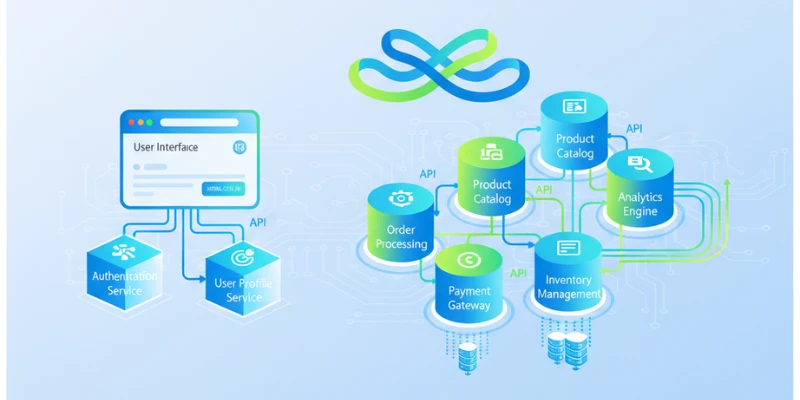
Full-stack development has become the norm for building modern web applications. As applications expand in size and complexity, developers frequently encounter difficulties related to scalability, maintainability, and deployment. This is where microservices architecture comes into the picture. For those looking to build a strong foundation in these concepts, enrolling in a Full Stack Developer Course in Mumbai at FITA Academy can offer the essential skills and understanding required to thrive.
But does it always make sense to use microservices in full-stack development? Let’s explore what microservices are, their benefits, and the right time to adopt them.
What are Microservices?
Microservices represent an architectural approach where an application is divided into smaller, self-contained services. Each service handles a particular function or feature and can be developed, deployed, and scaled on its own. These services interact with one another using lightweight communication protocols, usually through APIs.
Unlike monolithic applications, which have all functionalities integrated into a single codebase, microservices enable teams to handle and modify specific components of the application independently without impacting the entire system.
Benefits of Microservices in Full-Stack Development
When implemented correctly, microservices can bring several advantages to full-stack projects. Here are a few key benefits:
1. Scalability
Microservices make it easier to scale individual parts of an application based on demand. For example, if the user authentication feature is heavily used, it can be scaled independently without scaling the entire application. These are the kinds of practical use cases covered in a Full Stack Developer Course in Kolkata, where learners explore how microservices improve flexibility and performance in real-world applications.
2. Faster Development and Deployment
Since each microservice can be built and deployed separately, teams can work on different services at the same time. This results in speedier release cycles and faster resolution of bugs.
3. Technology Flexibility
Each service in a microservices architecture can use different programming languages or databases based on its specific requirements. Because of this versatility, developers can select the most appropriate tools for each task.
4. Improved Fault Isolation
If one microservice fails, it does not necessarily bring down the entire application. This isolation helps in building more reliable and resilient systems.
When Microservices Make Sense
While microservices offer many benefits, they are not suitable for every project. Here are some situations where adopting microservices in full-stack development makes sense:
1. Large and Complex Applications
If your application is expected to grow in terms of features, user base, or data processing needs, microservices can help manage complexity. Dividing the application into smaller services allows better organization and scalability. Master scalable architectures and modern development challenges by enrolling in the Full Stack Developer Course in Delhi. Build the skills to design robust, scalable full-stack applications.
2. Multiple Development Teams
When multiple teams are working on the same application, microservices allow them to work independently without interfering with each other’s code. This improves productivity and reduces integration issues.
3. Frequent Updates and Releases
If your project requires frequent updates or you want to roll out new features quickly, microservices allow you to deploy changes to a single service without affecting the entire system.
4. Need for High Availability
For applications where uptime is critical, microservices help isolate failures and ensure that unaffected parts of the application continue to work as expected.
When Microservices May Not Be the Best Choice
Despite their advantages, microservices come with their own set of challenges. They add complexity in terms of service communication, deployment, and monitoring. For small projects or early-stage startups, a monolithic approach may be more practical due to its simplicity.
If your application is small, has a limited user base, or does not require frequent changes, starting with a monolith is often the smarter choice. You can always refactor parts of the system into microservices later as the need arises.
Microservices are a powerful architectural pattern that can greatly benefit full-stack development, especially for large, complex, or rapidly evolving applications. They improve scalability, flexibility, and team productivity. If you’re looking to gain hands-on experience with these concepts, taking a Full Stack Developer Course in Pune can give you the skills needed to design and implement microservices effectively.
However, they are not a one-size-fits-all solution. Before adopting microservices, it is important to evaluate the scope of your application, the size of your team, and your long-term goals. When used at the right time and for the right reasons, microservices can be a game-changer for your full-stack projects.
Also check: Monorepos in Full Stack Development: Pros and Cons